Device Note
Mandarin Coordinator Workflow for Thermage FLX
How the Mandarin-language coordinator desk actually runs in Myeongdong, what to verify before you fly, and the realistic limits of language coverage.
The Mandarin-language coordinator is the single feature that makes Myeongdong tier-one mainland medical tourism work in the volume it does. On the Xiaohongshu (小红书) Myeongdong-clinic geotag, three of every four notes mention the coordinator by reference — '中文很流利' ('the Mandarin was fluent'), '微信对接很顺畅' ('the WeChat handoff went smoothly'), '不需要翻译' ('no translator needed'). The reverse is also true: the most common negative note pattern is the clinic that markets Mandarin coverage in the WeChat consult and then runs the in-person session through Korean-only staff with the coordinator absent. This page covers the full Mandarin coordinator workflow at Myeongdong Thermage FLX clinics in 2026 — pre-trip intake, in-clinic consultation, treatment-day handoffs, and post-trip follow-up — in the level of detail that the marketing materials usually skip.
Why Myeongdong has denser Mandarin coordinator coverage than Gangnam
Myeongdong has carried the larger share of mainland Chinese patient volume in central Seoul aesthetic medicine for more than a decade. The duty-free era from roughly 2010 to 2017 brought the first wave of Chinese consumer demand into the district, and the Mandarin-speaking workforce that built up around the cosmetics-and-tax-free trade did not disappear when the duty-free volume shifted; some of it migrated into the upper-floor clinic infrastructure. Gangnam — particularly Apgujeong-dong and Cheongdam-dong — built its foreign-patient infrastructure later and on a more premium-tier basis, which means Mandarin coverage exists but is concentrated at the higher fee tiers. The practical consequence in 2026 is that a tier-one mainland visitor walking into a verified mid-tier Myeongdong Thermage FLX clinic will more often encounter a Mandarin-speaking coordinator on the front desk than the equivalent walk-in to a mid-tier Gangnam clinic. The premium-tier coverage is comparable across both districts; the differential is at the mid-tier.
The pre-trip WeChat intake — how it actually starts
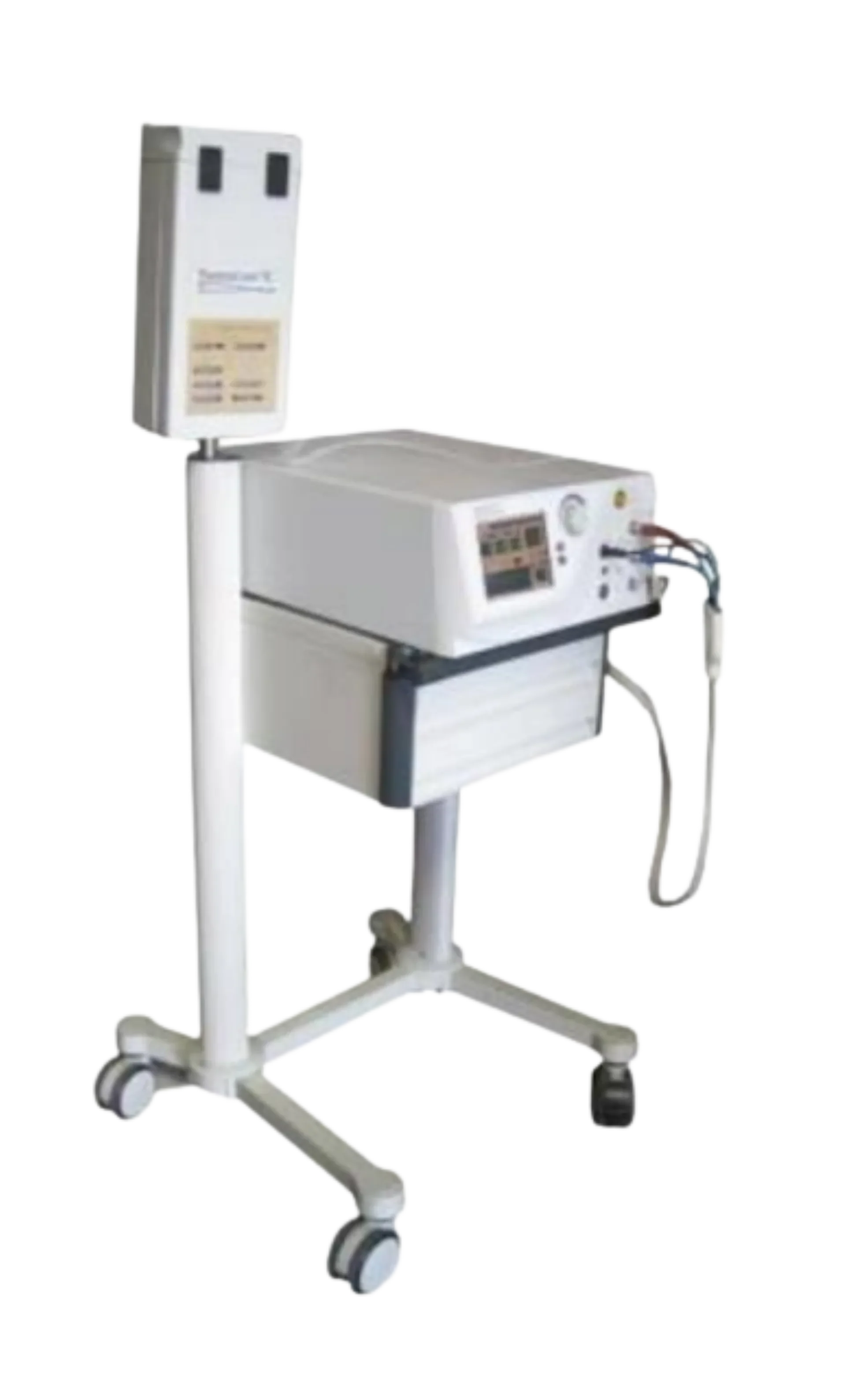
The standard Mandarin coordinator workflow for a tier-one mainland Thermage FLX trip begins on WeChat (微信) two to four weeks before the visit. The patient finds the clinic through Xiaohongshu (小红书), Weibo (微博), or a referral from a friend who treated previously, then adds the coordinator on WeChat through a QR code or WeChat ID published on the clinic's mainland-facing materials. The coordinator collects the basic intake — age, primary indication (jowl laxity, fine lines, periocular work), photographs of the current presentation in good lighting, any relevant medical history, and the planned travel dates. The coordinator then proposes a tentative protocol based on the photographs (full-face 600 versus 900 shots, single-platform versus combination programme) and quotes a directional KRW price range. The pre-trip intake is also where the patient should confirm the device verification: ask the coordinator to confirm in writing that the clinic operates the 4th-generation Solta Thermage FLX with Total Tip 4.0 and to send the device serial number for cross-check against the Solta Medical authorised-provider list at solta.com. Reputable clinics will provide this; clinics that resist this question should be removed from the shortlist.
What to verify on the WeChat consult before you fly
Tier-one mainland readers running the pre-trip WeChat consult should treat the conversation as a structured verification rather than a polite chat. Five items should be confirmed in writing before the trip is booked. First, the device — 4th-generation Solta Thermage FLX with Total Tip 4.0, serial number on file, photograph of the device in the clinic if available. Second, the protocol — shot count, energy levels by zone, expected session duration. Third, the all-in price — KRW figure with VAT included, payment methods accepted (Korean card, international Visa/Mastercard, Alipay or WeChat Pay if relevant), foreign-transaction fee disclosure. Fourth, the consultation-and-treatment timing — same-day or next-day, with the booking slots confirmed against the patient's flight schedule. Fifth, the post-trip follow-up channel — whether the coordinator continues to handle questions on WeChat after the patient flies back, and what the response window is. Where any of these five items are deflected or vague, the clinic warrants caution; reputable Myeongdong Thermage FLX clinics should answer all five items confidently within a 24-to-48-hour WeChat exchange window.
Treatment-day workflow — front desk to chair
On the treatment day itself, the standard Mandarin coordinator workflow at a Myeongdong Thermage FLX clinic runs through six stages. Stage one: patient arrives at the clinic, presents the passport at the front desk, and the coordinator who handled the pre-trip WeChat intake comes out to greet the patient — the continuity of the same coordinator across the WeChat-and-in-person handoff is one of the practical signals of a well-run clinic. Stage two: intake form, photographic baseline taken in standardized clinic lighting, brief review of any pre-trip changes to the indication. Stage three: physician consultation, with the coordinator translating between Korean physician and Mandarin patient or with a Mandarin-speaking physician depending on the clinic. The translation quality varies; tier-one patients should not hesitate to ask the coordinator to clarify any technical term that lands ambiguously. Stage four: protocol finalization with shot count, energy levels by zone, and consent form review — the consent form should be available in Chinese-language version at any clinic claiming Mandarin coverage. Stage five: pre-treatment numbing (topical anaesthesia for 30 to 45 minutes), payment processing during the numbing window. Stage six: the Thermage FLX session itself, typically 60 to 90 minutes, with the coordinator stepping in periodically if the patient signals discomfort or has questions during the session.
The realistic limits of Mandarin coverage
The honest disclosure that does not appear on most clinic marketing materials: Mandarin coverage in Myeongdong Thermage FLX clinics is dense but not uniform. Three realistic limits warrant tier-one mainland readers' attention. First, weekend coverage — many Myeongdong clinics run reduced Mandarin coordinator staffing on Saturdays and almost none on Sundays. Tier-one patients booking weekend treatment slots should confirm coverage explicitly rather than assume it. Second, after-hours emergency coverage — if a post-treatment concern arises at 22:00 on the day of treatment, the WeChat coordinator may not be available until the next morning, and the Korean physician on call may not speak Mandarin. Reputable clinics document the emergency contact protocol; less-organized clinics leave the patient to discover the gap. Third, the translation depth — coordinators handle conversational and standard clinical Mandarin fluently, but specialized regulatory or insurance-related terminology sometimes requires the patient to pause and clarify. Tier-one patients with complex medical histories should send the history in writing through WeChat in advance rather than relying on real-time translation in the consultation room.
Post-trip follow-up — what good clinics actually do
The post-trip follow-up window for a tier-one mainland Thermage FLX patient runs from the day after treatment through approximately month three, when the peak tightening response is assessable. Reputable Myeongdong clinics maintain WeChat (微信) coordinator contact across this window for questions about post-treatment redness, sun-protection discipline, regenerative bio-active timing, and the early visible response. Less-reputable clinics close the WeChat contact once the payment clears and the patient flies home. Tier-one mainland readers should confirm the post-trip support window explicitly during the pre-trip intake — ask the coordinator how long the WeChat support continues and what the response time commitment is. A reputable clinic will answer 'through your maintenance visit' or 'as long as you have questions about this treatment'; a poorly-run clinic will give a vague or evasive answer. The post-trip support window is one of the recurring differentiators on Xiaohongshu (小红书) coverage and warrants attention before the trip rather than after.
Red flags in the Mandarin coordinator workflow
Five recurring red flags in the Myeongdong Mandarin coordinator workflow warrant tier-one mainland readers walking away. First: the coordinator who refuses to confirm the device serial in writing — this is the platform-verification refusal and is the most reliable single signal of a clinic operating older or off-brand RF equipment. Second: the coordinator who quotes a price dramatically below the verified Myeongdong range — typically 40-plus percent below the lower bound shown in this archive's pricing page — without a documented combination programme or maintenance discount; the lowball price is usually attached to either platform substitution or shot-count substitution. Third: the coordinator who pressures same-day decision-and-payment during the WeChat consult before the patient has had time to compare across multiple clinics — reputable clinics expect comparison shopping and structure the workflow accordingly. Fourth: the coordinator who is replaced by a different person between the WeChat intake and the in-person treatment day, with no continuity of patient information — reputable clinics maintain consistency. Fifth: the coordinator who shuts down WeChat contact immediately after payment clears, leaving no post-trip support channel — the no-follow-up signature is the marker of a clinic optimizing for transaction volume over patient outcomes. None of these red flags are subtle; they are visible in the WeChat exchange before the patient books the flight.
“On Xiaohongshu the most common negative note is the clinic that promised Mandarin coverage on WeChat and ran Korean-only on the day. The continuity of the same coordinator across the WeChat-and-in-person handoff is the practical signal.”
Wang Yu-Han, editorial lead
Frequently asked questions
Do all Myeongdong Thermage FLX clinics have Mandarin coordinators?
Most do during weekday business hours. Coverage at premium-tier and mid-tier clinics is dense; coverage at the lowest-priced budget-tier clinics is uneven. Confirming through the pre-trip WeChat (微信) consult is the safer practice rather than assuming.
Can I book the consultation entirely on WeChat?
Pre-trip intake, protocol proposal, pricing quote, and booking slot confirmation are all standard on WeChat. The in-person consultation itself happens at the clinic on the day. The WeChat workflow handles approximately 60 to 70 percent of the information exchange before the patient lands.
What if the coordinator does not speak fluent Mandarin?
Some Myeongdong clinics run Chinese-Korean Korean-Chinese coordinators with intermediate fluency rather than native fluency. If the WeChat exchange is awkward or has obvious translation gaps, that is a signal to reconsider the clinic; a clinic claiming Mandarin coverage should deliver fluent native-or-near-native coverage.
Should I pay through the coordinator's WeChat or at the clinic?
Payment is at the clinic on the day of treatment, not through WeChat in advance. Some clinics request a deposit through bank transfer to confirm the booking; deposits are typically refundable up to 24-48 hours before the treatment date. Front-loaded full payment via WeChat before the trip is a red flag.
Is there a Mandarin-speaking physician at any Myeongdong FLX clinics?
A small number of Myeongdong clinics run Mandarin-speaking physicians directly, which removes the translation layer entirely. The majority run Korean physicians with Mandarin coordinator translation. Both workflows are workable; the direct-physician version is faster and less ambiguous in the consult room.
Can the coordinator handle hotel and flight bookings?
No. Reputable Myeongdong clinics do not operate as travel agencies and will refer hotel-and-flight questions to standard channels (Booking, Agoda, Trip.com, Korean carrier websites). The coordinator's scope is the medical-tourism workflow itself, not the broader trip logistics.
What languages besides Mandarin are common in Myeongdong?
English coverage is broad across most Myeongdong FLX clinics. Japanese coverage is dense at clinics with significant Japanese patient volume. Cantonese coverage exists but is less standardized than Mandarin; tier-one Hong Kong patients are typically comfortable in either Mandarin or English at most Myeongdong clinics.
How do I find the coordinator's WeChat ID?
Through the clinic's mainland-facing materials — Xiaohongshu (小红书) account, Weibo (微博) account, or the foreign-patient page on the clinic website. Clinics that operate without a published WeChat coordinator contact for tier-one mainland readers are typically not optimized for this patient segment and warrant a different shortlist.