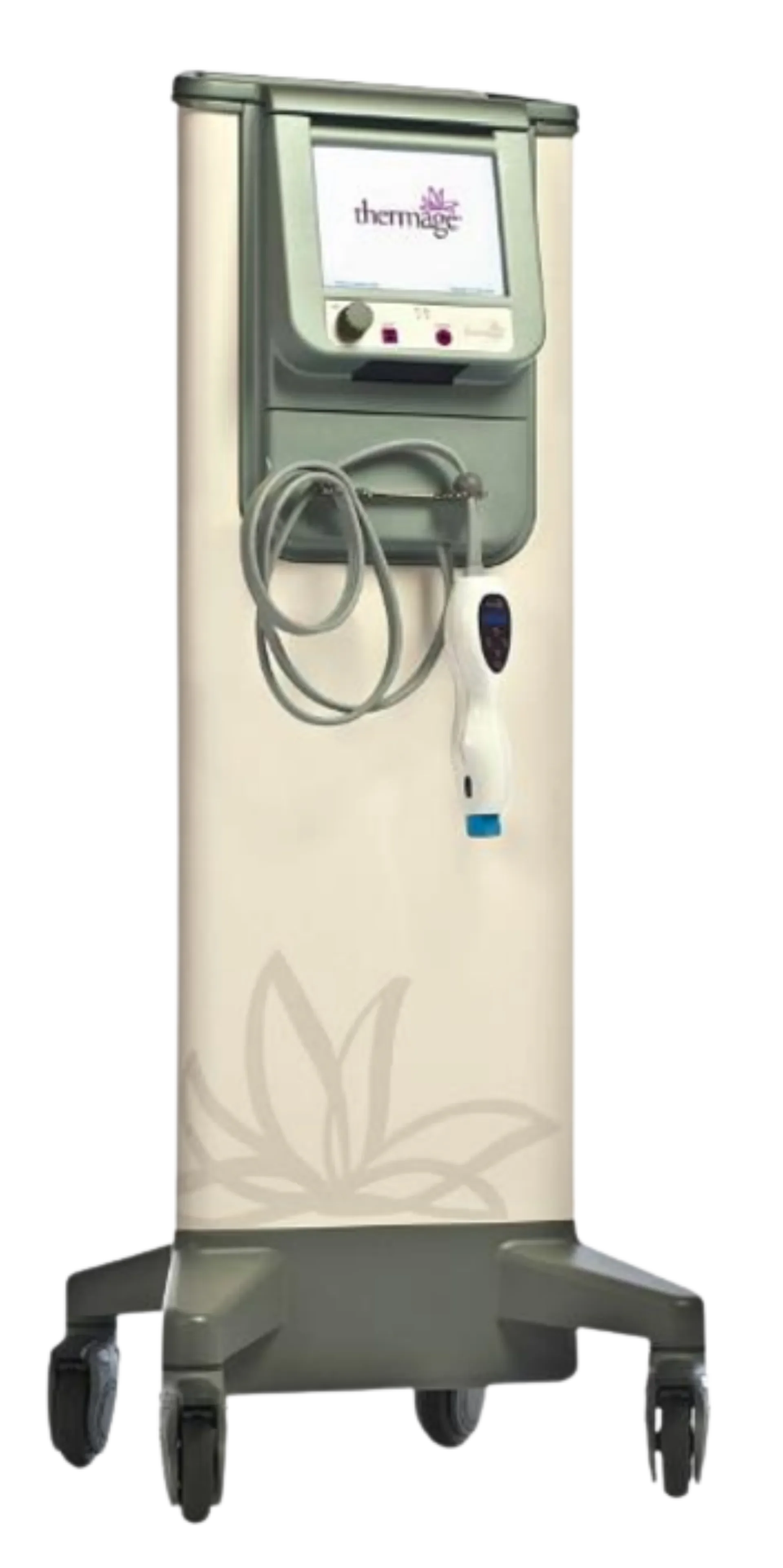
Device Note
Douyin Aesthetic Trends and Thermage FLX in Myeongdong
The Douyin (抖音) short-video aesthetic dictionary, decoded for tier-one mainland readers researching 4th-generation Solta Thermage FLX in the Myeongdong clinic corridor.
Douyin (抖音) is not the same internet as Xiaohongshu (小红书). The platform compresses an aesthetic discussion into nine seconds of vertical video and a single phrase the algorithm has learned to surface — 山根 (shan-gen, the nasal root), 苹果肌 (ping-guo-ji, the apple-cheek), 下颌缘 (xia-he-yuan, the mandibular line), 法令纹 (fa-ling-wen, the nasolabial fold). For tier-one mainland readers in 2026, Douyin has become the place where the visual vocabulary of post-Thermage-FLX skin response gets named, normalised, and compared. The Myeongdong clinic corridor — denser in Mandarin-speaking coordinator infrastructure than any other Seoul district — sits at the intersection of those trends and the actual treatment outcome. This essay decodes the Douyin aesthetic dictionary as it overlaps with what 4th-generation Solta Thermage FLX is actually capable of delivering, and where the platform's compressed reveal format quietly distorts patient expectation. A reader expecting a Douyin reveal in week one but receiving a peer-reviewed week-eight-to-twelve collagen-remodelling timeline has booked the wrong mental model, not the wrong treatment.
The Douyin aesthetic dictionary, and which terms map to Thermage FLX
The Douyin (抖音) short-video aesthetic conversation runs on a vocabulary that has stabilised over the past three years. The most-discussed terms in 2026, by reverse-engineered hashtag volume, are 山根 (the nasal-root frame), 苹果肌 (the apple-cheek volume), 下颌缘 (the mandibular margin), 法令纹 (the nasolabial fold), and 颈纹 (jing-wen, the neck horizontal lines). Of these, 4th-generation Solta Thermage FLX maps cleanly onto three: the mandibular margin tightening, the nasolabial fold softening, and the neck-line response. The platform's monofilament-RF mechanism — the volumetric heating of the dermal-subdermal junction to a target temperature in the 55-65°C band, with surface cooling — is structurally suited to the lower-face and upper-neck zones where collagen-fibre laxity drives the visible Douyin trend signals. The two terms FLX does not map onto cleanly are 山根 (which is a volumetric or filler conversation) and 苹果肌 (which is a midface volume conversation, more aligned with HIFU-based or filler-based protocols). Tier-one mainland readers should hold this mapping in mind when scrolling Douyin: the platform conflates the categories, but the underlying clinical mechanisms do not.
Why the Douyin 'reveal' format distorts the Thermage FLX timeline
The dominant Douyin (抖音) format for aesthetic procedures is the before-and-after reveal compressed into a single nine-to-fifteen-second clip, with the post-treatment frame typically shot one to seven days after the procedure. This format works well for filler-based and toxin-based interventions, where the visible response is mechanically immediate. It works poorly for 4th-generation Thermage FLX, where the visible response is collagen-mediated and follows a peer-reviewed eight-to-twelve-week timeline before peak response. The Douyin compression problem is that the format selects for the day-one tightness — the so-called 'immediate' skin contraction that comes from acute collagen-fibre shortening at the moment of RF energy delivery — which is real, measurable, and clinically modest, and which is also not the response the patient ultimately pays for. The Solta Medical clinical literature and the broader peer-reviewed dermatology record (cross-referenced through PubMed on the controlled monofilament-RF studies) consistently show that the meaningful collagen-remodelling response peaks in the week-eight-to-twelve window. Tier-one mainland readers researching Myeongdong Thermage FLX through Douyin should treat the day-one reveal as a teaser, not as the deliverable. The deliverable arrives in week ten.
The Douyin mandibular-line trend, and what FLX actually delivers there
The single most-discussed Douyin (抖音) Thermage trend in 2026 is the 下颌缘 (mandibular-line) sharpening — the post-treatment vertical-video frame where the jaw shadow has visibly returned, the soft-tissue droop at the gonial angle has lifted, and the patient turns slowly to the side to show the V-line silhouette. The honest reading from the Myeongdong clinical experience is that 4th-generation FLX does deliver a measurable mandibular-line response in a meaningful proportion of patients, with the response strongest in the 30-to-50 age band where the soft-tissue laxity is genuine but the skeletal frame is intact. The response is not the surgical V-line that Douyin sometimes implies — the platform's algorithmic amplification of the most dramatic reveals creates a survivorship-bias problem where the median FLX response gets visually outrun by the outlier results that drive engagement. A tier-one mainland patient with realistic expectations — a 20-to-35 percent visible reduction in mandibular soft-tissue droop, peaking at week ten, holding through month twelve to eighteen — is well-served by the Myeongdong FLX option. A patient expecting the algorithmic outlier is going to be disappointed by the median outcome, no matter which clinic they choose.
The Douyin nasolabial-fold conversation, and the Myeongdong protocol response
The 法令纹 (nasolabial-fold) conversation on Douyin (抖音) sits in a different clinical register from the mandibular-line conversation. The nasolabial fold is structurally driven by midface volume descent rather than by skin laxity alone, which means the Thermage FLX response in this zone is real but typically modest in isolation. The Myeongdong clinical pattern in 2026 is to position FLX as the foundational laxity-and-tightening layer with a planned secondary intervention — either a midface volume protocol or a HIFU-based contouring layer — handling the volumetric component. The honest disclosure for tier-one mainland readers: a single FLX session targeting the nasolabial fold zone in isolation is not the right protocol design, regardless of how the Douyin reveal videos position the result. A reputable Myeongdong consultation will name this directly during the protocol-proposal stage and either propose the layered approach or decline the single-zone intervention. Where a clinic enthusiastically books a single-zone nasolabial FLX session without raising the layered-protocol consideration, that is a soft negative signal that the clinic is optimising for booking conversion rather than for patient outcome.
The shot-count question, and how Douyin distorts it
Douyin (抖音) discussion of Thermage FLX repeatedly anchors on shot count — 600 shots, 900 shots, 1200 shots — as a proxy for treatment intensity and therefore for value. The reality from the Myeongdong clinical workflow is that shot count is one of three protocol variables, not the dominant one. The other two are tip generation (the 4th-generation FLX 900-shot tip is the current standard, with the earlier 3rd-generation 600-shot tip and the older Thermage CPT line being clinically inferior for most 2026 protocols) and energy-level mapping by facial zone (the per-zone energy-level customisation that a well-trained physician adjusts during the treatment). A 900-shot FLX protocol with appropriate per-zone energy-level mapping delivers more clinical response than a 1200-shot protocol where the energy levels are dialled uniformly low to make the treatment painlessly tolerable for a comparison-shopping patient. The Douyin emphasis on shot-count maximisation is, in clinical terms, the wrong variable to optimise. Tier-one mainland readers should ask the consulting physician for the per-zone energy-level map and the tip-generation confirmation in writing, and should treat the shot count as the third variable, not the first.
The Douyin coordinator-recommendation trend, and the verification problem
A growing share of Douyin (抖音) Thermage content in 2026 is produced by Mandarin-speaking medical-tourism coordinators rather than by patients, and the format is increasingly hard to distinguish from authentic patient notes. The coordinator-produced clip will show a physical clinic environment, a coordinator's WeChat (微信) QR code, a price quote in RMB equivalents, and a verbal recommendation that the viewer book through that coordinator's WeChat. The structural problem is that this content lives in the regulatory grey zone — coordinator-mediated medical-tourism arrangements that may or may not involve appropriate KHIDI registration, that may or may not route the patient to a Solta Medical authorised-provider clinic, and that operate on a referral-fee structure the viewer is generally not informed about. Tier-one mainland readers should treat Douyin coordinator recommendations as one input among many, and should cross-verify the recommended clinic against the Solta Medical authorised-provider list and against the KHIDI international-medical-services registration. Where the coordinator resists either verification, that is a hard negative signal. The reputable Mandarin-speaking coordinators operating in Myeongdong will welcome both verifications and will provide the clinic's KHIDI registration number on request.
How to read a Douyin Thermage post in 2026, step by step
A practical Douyin (抖音) reading protocol for tier-one mainland readers researching Myeongdong Thermage FLX in 2026 runs through six steps. First, note the timeline — is the reveal frame shot one day, one week, or one month after the procedure, and does the timing match the peer-reviewed eight-to-twelve-week peak-response window. Second, identify the trend term — 下颌缘, 法令纹, 颈纹, 苹果肌 — and confirm it maps onto a zone where Thermage FLX has a clinically established response. Third, check whether the clip mentions tip generation (4th-generation FLX) and shot count, and treat the absence of both as a soft negative signal. Fourth, scan the comments for verified-platform discussion or for the specific clinic name, and search both independently against the Solta Medical authorised-provider list. Fifth, weight the account's posting history — accounts with thin histories, accounts that post only Thermage content, or accounts that pivot to a WeChat (微信) coordinator pitch in the caption are operating in the coordinator-marketing layer rather than the patient-note layer. Sixth, cross-reference one Xiaohongshu (小红书) longer-form note for the same trend term and the same clinic mention. Two platforms agreeing is a meaningful signal; one platform alone is a starting hypothesis.
“Douyin shows the day-one tightening. Solta Medical's literature shows the week-ten peak. Tier-one mainland patients who book Myeongdong Thermage FLX off the day-one reveal are buying the teaser. The deliverable arrives in week ten.”
Wang Yu-Han, editorial lead
Frequently asked questions
Are Douyin Thermage reveals trustworthy as a research source?
Partially. Douyin (抖音) compresses the post-treatment response into a one-to-seven-day reveal window, which is structurally before the peer-reviewed eight-to-twelve-week peak-response window for Solta Medical's monofilament-RF mechanism. The reveals are visually real but timing-mismatched. Use Douyin as one input among several and cross-verify against Xiaohongshu (小红书) longer-form notes.
Which Douyin trends actually align with what Thermage FLX delivers?
The mandibular-line (下颌缘) sharpening and the neck horizontal lines (颈纹) softening map cleanly onto Thermage FLX's volumetric dermal-heating mechanism. The apple-cheek (苹果肌) volume conversation and the nasal-root (山根) frame are volumetric or filler conversations and do not map onto FLX in isolation.
Should I trust a Douyin coordinator's clinic recommendation?
Treat it as one input among several. Cross-verify the recommended Myeongdong clinic against the Solta Medical authorised-provider list and against the KHIDI international-medical-services registration. Where the coordinator resists either verification, that is a hard negative signal.
Is the Douyin shot-count emphasis clinically meaningful?
Not as much as the platform suggests. Shot count is one of three protocol variables — the others are tip generation (4th-generation FLX vs earlier platforms) and per-zone energy-level mapping. A 900-shot 4th-generation FLX protocol with appropriate energy-level customisation delivers more clinical response than a 1200-shot protocol with uniformly low energy levels.
Why do Douyin reveals look more dramatic than what I see at week one?
Douyin (抖音) algorithmically amplifies the most dramatic reveals through engagement-driven feed selection, which creates a survivorship-bias effect. The median patient response — a 20-to-35 percent visible reduction in target-zone laxity, peaking at week ten — is less algorithmically rewarded than the outlier reveals. Calibrate your expectation to the median, not to the algorithm.
Can a single FLX session deliver the Douyin V-line outcome?
For most patients in the 30-to-50 age band with genuine soft-tissue laxity but an intact skeletal frame, a single 4th-generation FLX session delivers a meaningful but not surgical mandibular-line response. The 'V-line surgery' outcome that some Douyin reveals imply involves osteotomy, not RF, and is a different category of intervention entirely.
Should I screenshot Douyin clips to show the Myeongdong physician?
Yes — bringing reference images to the consultation is a productive practice, and reputable Myeongdong physicians will engage with the images directly. The physician will tell you which Douyin (抖音) reveals are within FLX's clinical envelope and which are not, which is exactly the information a tier-one mainland reader benefits from receiving before booking the treatment.
How long after the Myeongdong FLX session can I film my own Douyin reveal?
If you are filming the day-one or week-one frame, you are filming the acute collagen-fibre shortening response rather than the peak collagen-remodelling response. The peer-reviewed peak-response window is week eight to twelve, which is when the visible result is most fully expressed. Filming both windows and posting them as a paired clip is the more honest reveal format.