Value-to-Spec Pick
10 Hotels for Every Budget Near Myeongdong
A Shanghai-based editor's reading of ten central-Seoul hotels — heritage luxury, lifestyle design, upper-midscale workhorses, and a Hongdae design property within one subway line — assembled around a working Myeongdong trip.
Myeongdong, in my reading, is the rare central-Seoul district where the hotel stack is genuinely layered — heritage luxury at the top, a serious upper-midscale band in the middle, and a deep bench of midscale options that handle international visitors with more competence than their pricing suggests. The geography helps. Sogong-ro on the western edge holds the older luxury cluster — the Westin Josun's century of operation, the Plaza facing the City Hall plaza, the Lotte flagship attached directly to its own department store and duty-free floor. Toegye-ro at the southern edge anchors the lifestyle and upper-midscale band, with the L7 Myeongdong leading the design-forward Lotte sub-brand and the long-running Sejong Hotel sitting directly above the subway exit. The interior of the district itself — Myeongdong-gil and Myeongdong 8-gil — holds the rooms that put a visitor inside the shopping circuit at street level. And on the far edge of the working radius, a single Line 2 ride away, the Hongdae design-hotel cluster supplies the lifestyle property that travellers splitting time between central Seoul and the design-school district will want to know about. The ten rooms below are organised not by stars or score but by the working pattern of a tier-one Seoul trip — the order moves from heritage-luxury anchors through the upper-midscale workhorses to the design and midscale options that close the budget tail. None of the inclusions carries a commercial relationship with this publication; the rooms here are the rooms that have actually held their conversation across two or three consecutive Seoul stays since 2023. On Xiaohongshu (小红书) the Myeongdong-hotel geotag pulls roughly 200,000 long-form notes; the price differential against Pudong or Jing'an for an equivalent-tier room runs 30 to 45 percent for the upper-midscale band and 25 to 35 percent for the heritage luxury. What recommends a hotel here is rarely the room itself but the cadence of the morning walk from lobby to breakfast to the first appointment of the day, and that walk is what the section below tries to describe honestly.
How this list was assembled, and on what reasoning
This list is a categorical edit of ten hotels — not a ranking — selected on four working criteria. The room must sit within a fifteen-minute walk or single-stop subway ride of central Myeongdong, defined here as the Myeongdong-gil and Myeongdong 8-gil intersection that anchors the shopping district. The property must operate at a level of language support that handles English, Mandarin, and Japanese visitors at the front desk without negotiation — which, for a tier-one Asian medical-tourism circuit, is the baseline rather than the upgrade. The pricing must be honest to the tier — heritage-luxury rooms quoted at the heritage-luxury band, upper-midscale rooms at the upper-midscale band, midscale rooms at the midscale band — without the spread-positioning that some of the larger chains use to obscure their actual average daily rate. And the room must compose well with a working Seoul trip pattern that includes either a treatment day with a single-clinic appointment, a shopping-and-palace itinerary that uses Myeongdong as a base, or a layered editorial trip that splits days across Sogong, Bukchon, and the Hongdae design-school cluster. Pricing references are accurate to the most recent verified booking at standard published rates; readers planning a careful first-time Seoul stay should verify pricing the day of booking and watch the seasonal calendar for the Lunar New Year period, Chuseok, and the cherry-blossom and autumn-foliage windows that warm the entire central-Seoul hotel stack by 20 to 40 percent. None of the listed properties has any commercial relationship with this publication.
What is held back from this edit, and why
Three categories are deliberately excluded. First, the very-luxury Cheongdam and Yongsan-Hannam properties — the Shilla, the Grand Hyatt's Hannam wing, the small-key boutique rooms above the Galleria — sit outside the working Myeongdong radius and belong on a separate central-Seoul editorial. Second, the airport-adjacent rooms at Incheon and Gimpo, which a treatment-day trip with a same-day flight will sometimes anchor at, are covered in a separate logistics article and not duplicated here. Third, the budget tier below the midscale band — the small business hotels on Toegye-ro 12-gil and around — handles travellers competently but does not, in my reading, reach the editorial threshold for a categorical edit of this kind; a separate budget-tier guide is in preparation. The Myeongdong-perimeter mid-luxury Korean chain hotels are included where they meet the four working criteria; properties that sit immediately outside the perimeter are included only when they offer a distinctive editorial reason to extend the walking radius.
Featured A — The Westin Josun Seoul, Sogong-ro
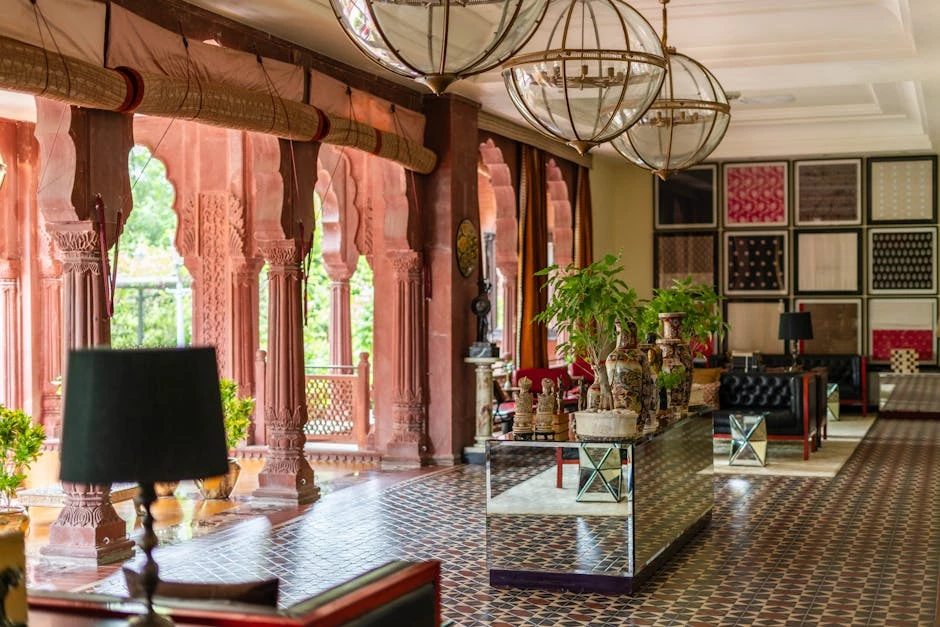
The Westin Josun is, in my reading, the canonical Sogong-ro heritage anchor — a property that has operated continuously since 1914 and reads, on first impression, as the room that the rest of the central-Seoul luxury stack has had to position around for the past century. The address at 106 Sogong-ro places the entry lobby on the western edge of Myeongdong proper, with the duty-free corridor on Eulji-ro and the Lotte Department Store main wing both visible from the upper-floor rooms. The pricing tier sits firmly in the heritage-luxury band, with standard rooms quoted at 30 to 45 percent below an equivalent Westin in Pudong or Jing'an for the comparable season. The front-of-house operation handles English, Mandarin, and Japanese visitors with the calm of a property that has spent a century training for the brief. The morning breakfast service runs in the ground-floor restaurant and on the second-floor club lounge, with the latter calibrated for the longer-stay business and editorial reader; the differential is meaningful for a working stay of three or more nights. The location is the principal recommendation — five minutes on foot to the Myeongdong-gil shopping spine, four minutes to the Lotte duty-free flagship, eight minutes to City Hall, and ten minutes through the Cheonggyecheon stream walk to the Euljiro printing-alley district. The protocol of arriving on the heritage-luxury tier here is the protocol that travellers from tier-one mainland cities default to on a first careful Seoul stay; subsequent stays often migrate to the more lifestyle-oriented options listed below, but the Westin Josun remains the architectural and operational reference against which the rest of the stack is read. A practical note for the careful visitor: the autumn and spring foliage windows warm the room availability to a noticeably tighter calendar than the broader luxury stack, and booking three to four months ahead reads as the courteous practice rather than an aspirational ceiling.
- Tier: heritage luxury (24h check-in, 3pm in / noon out)
- Strengths: 1914 heritage operation, Sogong-ro anchor location, club lounge for longer stays
- Languages: English / Mandarin / Japanese front-of-house
- Walk to Myeongdong-gil: five minutes
Featured B — Lotte Hotel Seoul, Main and Executive Tower
Lotte Hotel Seoul is the Lotte Group's flagship luxury property and sits, in my reading, at the centre of the Sogong cluster — the address at 30 Eulji-ro places the entry corridor between the Westin Josun and the Lotte Department Store main flagship, with the Lotte Duty Free wing directly attached to the hotel's lower floors via a covered pedestrian connection. The differential against the Westin Josun is principally one of operating logic rather than tier: the Lotte reads as a heritage-luxury property built around the broader Lotte commercial estate, with the duty-free and department-store integration delivering a recognisable operating advantage for travellers whose Seoul trip is anchored on shopping. The room inventory splits across the Main building (the older heritage-luxury rooms) and the Executive Tower (the more recent refurbishment with the higher floors and the broader Han River view from the upper categories). Pricing sits firmly in the heritage-luxury band, with the Executive Tower commanding a 10 to 15 percent premium over the Main building rooms for the equivalent category. The in-house Mandarin-speaking concierge programme is, in my reading, the most carefully assembled in the central-Seoul stack and is meaningfully useful for tier-one mainland visitors. The protocol of choosing between the Lotte and the Westin Josun for a first careful Seoul stay reduces to whether the trip prioritises duty-free integration (Lotte) or the older heritage-architectural register (Westin Josun); both rooms operate at the same heritage-luxury tier. A practical note for the careful visitor: the Lotte Hotel runs an in-house Mandarin coordinator desk that the Executive Tower categories access without surcharge, which reads as a meaningful operating differential for a tier-one mainland visitor planning a treatment-day appointment in central Seoul.
- Tier: heritage luxury (24h)
- Strengths: Lotte Duty Free direct access, Mandarin coordinator desk, Executive Tower upper-floor views
- Languages: English / Mandarin / Japanese front-of-house
- Walk to Myeongdong-gil: five minutes
Featured C — The Plaza Seoul, Autograph Collection
The Plaza Seoul sits at 119 Sogong-ro directly facing the Seoul Plaza and Deoksugung Palace, and is, in my reading, the central-Seoul boutique-luxury room — the property that the regional hospitality press has covered through three consecutive seasonal rotations as the room that recommends itself to the editorial reader who prefers a smaller key count to the larger heritage-luxury cluster. The Autograph Collection positioning under Marriott's editorial sub-brand is meaningful: the room categories read closer to a European boutique-luxury property than to the larger Korean-chain luxury cluster, with the design programme rotated through a careful annual cadence. The address places the entry on the Seoul Plaza side, with the Deoksugung palace gate visible from the upper-floor rooms facing west. The walk to Myeongdong-gil runs eight to ten minutes, slightly longer than the Sogong-ro cluster but compensated by the architectural reading of the morning walk through the City Hall plaza. Pricing sits in the upper-end of the heritage-luxury band, often within 10 percent of the Westin Josun's standard category. The morning breakfast service runs in the second-floor restaurant and is the better-paced morning across the heritage-luxury cluster for an editorial reader who prefers a quieter room. A practical note: the Deoksugung-facing rooms on the upper floors carry a particular editorial weight in the spring cherry-blossom and autumn foliage windows, and the foliage-season pricing premium runs roughly 25 to 35 percent above the standard rate; booking four to five months ahead reads as the courteous practice for those windows.
- Tier: heritage luxury, boutique-luxury sub-band (24h)
- Strengths: Deoksugung-facing rooms, Autograph Collection editorial register, smaller key count
- Languages: English / Mandarin / Japanese front-of-house
- Walk to Myeongdong-gil: eight to ten minutes
Featured D — Lotte Hotel L7 Myeongdong, Toegye-ro
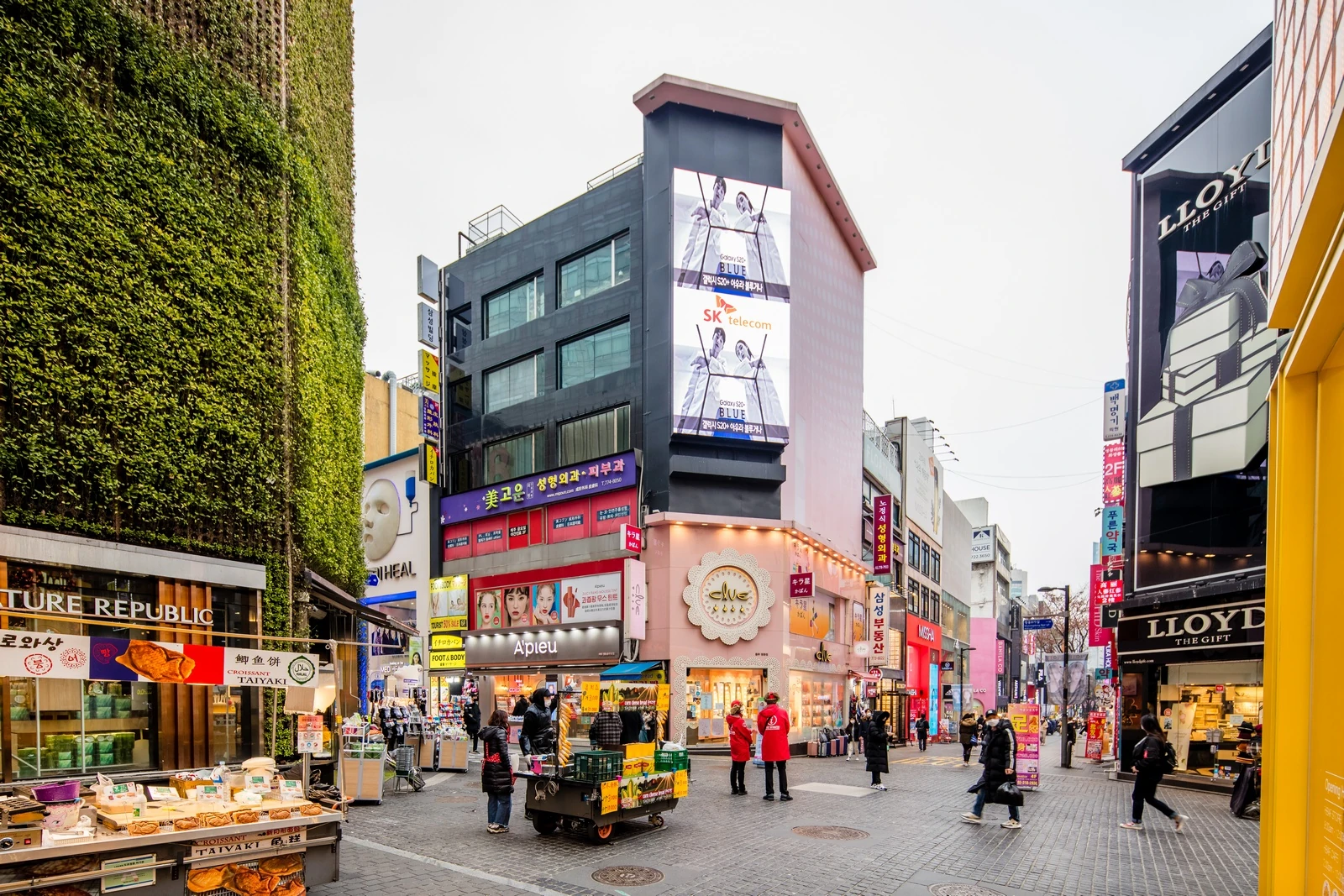
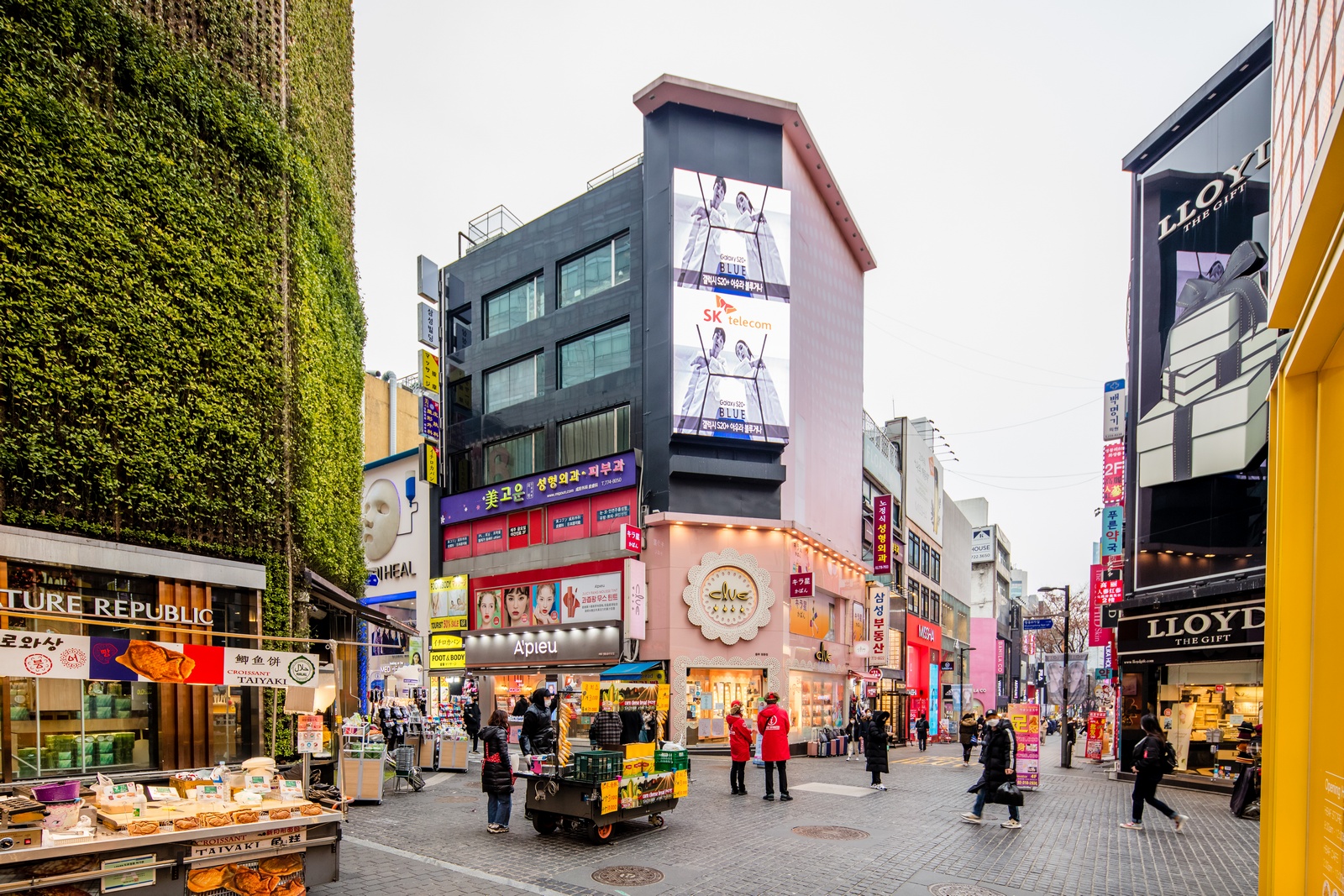
L7 Myeongdong is Lotte's design-forward upper-midscale sub-brand, sitting at 137 Toegye-ro on the southern edge of Myeongdong proper, and is — in my reading — the room that the careful tier-one mainland visitor migrates to on a second or third Seoul stay once the heritage-luxury anchor has been understood and the trip pattern shifts toward a longer working visit. The L7 brand operates a deliberately younger editorial register than the Lotte Hotel Seoul flagship — the lobby reads closer to a Pudong design hotel than to a heritage-luxury property, the rooms run a more saturated colour palette across the standard categories, and the in-house dining and rooftop bar programme is positioned for a lifestyle visitor rather than a heritage-luxury reader. The address on Toegye-ro places the entry directly on the Myeongdong Station southern access road, with Exit 6 a two-minute walk from the lobby. Pricing sits firmly in the upper-midscale band, typically 35 to 50 percent below the Lotte Hotel Seoul flagship for the equivalent night, which represents the most defensible value-to-spec ratio (性价比) across the central-Seoul stack for a working trip of four to seven nights. The front-of-house operation handles English, Mandarin, and Japanese visitors with the same Lotte-group operating depth as the flagship. The standard category is generously sized for the upper-midscale tier and is the room I would book for a working stay of more than three nights. The rooftop pool and bar reads as one of the better central-Seoul lifestyle programmes at the upper-midscale tier and pairs cleanly with the broader Myeongdong shopping pattern.
- Tier: upper midscale (24h)
- Strengths: design-forward sub-brand, rooftop pool and bar, southern Myeongdong location with subway access
- Languages: English / Mandarin / Japanese front-of-house
- Walk to Myeongdong-gil: four to five minutes
Featured E — Sejong Hotel Seoul Myeongdong
The Sejong Hotel sits at 145 Toegye-ro directly above Myeongdong Station Exit 10, and is the longest-running independent hotel in the Myeongdong perimeter — a property that has operated for decades and reads as a quietly competent upper-midscale room that does not attempt to compete on lifestyle programming or design refresh but instead delivers a recognisable, consistent operating standard that travellers from the broader region default to on a working stay. The architecture is straightforwardly older Korean hotel; the lobby reads as a property of its operating period rather than the more recent design refresh cycle of the L7 or the Solaria Nishitetsu. The Toegye-ro address places the entry essentially on top of the subway exit, which is the operating recommendation for the Sejong above any other consideration; for a visitor who values subway access over design programming, the Sejong is the room. Pricing sits in the upper-midscale band, usually 10 to 20 percent below the L7 Myeongdong for the equivalent category. The front-of-house operation handles English, Mandarin, and Japanese visitors with the operating depth of a property that has spent decades training for the brief; the breakfast service is competent rather than exceptional, which one should not mistake for a weakness. A practical note: the upper-floor rooms on the south-facing side run a noticeably better light than the lower categories, and the seasonal premium for the higher floors runs roughly 10 to 15 percent above the standard rate.
- Tier: upper midscale (24h)
- Strengths: above Myeongdong Station Exit 10, longest-running independent in Myeongdong, value-to-spec ratio
- Languages: English / Mandarin / Japanese front-of-house
- Walk to Myeongdong-gil: three to four minutes
Featured F — Solaria Nishitetsu Hotel Seoul Myeongdong
Solaria Nishitetsu is the Japan-headquartered hotel brand's central-Seoul flagship, at 9 Myeongdong-gil directly on the main shopping spine, and is the upper-midscale room that travellers from the broader Japanese visitor market default to on a careful Seoul stay; the Japanese-visitor coverage is meaningfully deeper than the broader Korean upper-midscale cluster. The address places the entry directly on Myeongdong-gil, with the shopping spine extending in both directions from the hotel's ground-floor doorway; for a visitor whose trip is principally anchored on Myeongdong shopping, the Solaria is the room. The room categories run a deliberately tighter Japanese-business-hotel format — the standard rooms are more compact than the L7 or Sejong equivalents but read as the work of an operator who has thought about the differential between a working overnight and a longer stay. Pricing sits in the upper-midscale band, typically within 5 to 10 percent of the L7 Myeongdong for the equivalent night. The in-house spa programme on the lower levels is a particular note for a visitor planning a longer working stay. A practical note: the upper-floor Myeongdong-gil-facing rooms run a noticeably louder evening soundscape than the rear-facing categories, with the shopping-spine pedestrian flow running into the late evening hours; for a visitor planning a treatment-day appointment with an early morning, the rear-facing categories are the room I would book.
- Tier: upper midscale (24h)
- Strengths: directly on Myeongdong-gil, deepest Japanese-visitor operating culture, in-house spa
- Languages: English / Mandarin / Japanese front-of-house
- Walk to Myeongdong-gil: zero — on the spine itself
Featured G — Hotel Skypark Central Myeongdong
Hotel Skypark is a Korean midscale chain with multiple Myeongdong properties, and the Central Myeongdong location at 16 Toegye-ro 12-gil is the chain's most representative central-Seoul room — a quietly competent midscale property that travellers prioritising location and price over design programming default to on a careful Seoul stay. The Toegye-ro 12-gil address places the entry on a small side street two minutes south of the main Toegye-ro spine and four to five minutes from Myeongdong-gil. The room categories run a recognisably midscale format — compact standard rooms, a small inventory of deluxe categories on the upper floors, and a tight operating budget that reads honestly in the room finishes rather than attempting to spread-position above the tier. Pricing sits firmly in the midscale band, usually 40 to 55 percent below the L7 Myeongdong for the equivalent night, which makes the property the value-to-spec recommendation on this list for a working trip principally anchored on budget. A practical note: the Skypark chain operates several Myeongdong properties at varying tier positioning, and a booking should confirm the Central Myeongdong location specifically rather than defaulting to the nearest Skypark in the search results. For a treatment-day visitor planning a budget-conscious working stay of three to four nights, the property is the recommended midscale room on this list.
- Tier: midscale (24h)
- Strengths: value-to-spec ratio (性价比), central Myeongdong location, consistent operating standard
- Languages: English / Mandarin / Japanese front-of-house
- Walk to Myeongdong-gil: four to five minutes
Featured H — Nine Tree Premier Hotel Myeongdong II
Nine Tree Premier Myeongdong II sits at 28 Myeongdong 8-gil on a quieter side spine of the main shopping district, and is the upper-midscale alternative for the visitor who wants to stay directly on the Myeongdong street register but prefers a slightly less heavily trafficked block than the main Myeongdong-gil corridor that the Solaria anchors. The Nine Tree brand operates a mid-luxury Korean chain register that reads above the standard upper-midscale band but below the L7's design-forward programming. The address places the entry on Myeongdong 8-gil, with the main shopping spine two minutes on foot through the cross-streets, the duty-free corridor four minutes, and the Lotte Department Store main wing five minutes. Pricing sits in the upper-midscale band, typically within 5 to 10 percent of the L7 Myeongdong's standard category; the differential against the Solaria runs in the direction of the Nine Tree's slightly more generous room dimensions, against a slightly less Japanese-visitor-prepared operating culture. The breakfast service reads as the better-paced morning across the upper-midscale cluster for a working visitor on a four-to-seven-night stay. A practical note: the Nine Tree Premier brand operates several central-Seoul properties at varying tier positioning, and the Myeongdong II location specifically is the room I would book for the Myeongdong 8-gil register. The hotel's location on the quieter shopping side spine is the principal editorial differentiator against the Solaria Nishitetsu on the main spine.
- Tier: upper midscale, mid-luxury Korean chain sub-band (24h)
- Strengths: Myeongdong 8-gil side-spine quiet, generous room dimensions, consistent breakfast service
- Languages: English / Mandarin / Japanese front-of-house
- Walk to Myeongdong-gil: two to three minutes
Featured I — RYSE, Autograph Collection, Hongdae
RYSE is the design-led Autograph Collection property at 130 Yanghwa-ro in the Hongdae district, and sits — in my reading — outside the immediate Myeongdong perimeter but firmly inside the working radius of a tier-one Seoul trip that splits days across the central shopping district and the Hongdae design-school neighbourhood. The address places the entry on Yanghwa-ro at the edge of the Hongdae design-school district, with Hongdae's club and gallery cluster within a ten-minute walk and the Hongdae Station Line 2 subway gate three minutes on foot from the lobby; the working transit from RYSE to central Myeongdong runs roughly 25 to 30 minutes on the subway via Hongik University Station to Euljiro 1-ga, which is the operating window that a careful visitor needs to understand before booking. The property is widely covered in the international hospitality and design press — the broader regional press has run the RYSE through two consecutive editorial cycles as the central-Seoul design-hotel reference — and the architectural register reads as the work of a property that has thought carefully about the differential between an editorial-reader stay and a tier-one luxury anchor. Pricing sits in the lifestyle-luxury band, typically 15 to 25 percent below the Westin Josun and the Lotte Hotel for the equivalent night, with the design-forward upgrades on the upper floors commanding a meaningful premium. The front-of-house operation handles English, Mandarin, and Japanese visitors with the careful pacing of a smaller key-count design property; the in-house bar and restaurant programme is, in my reading, one of the better-paced lifestyle programmes in central Seoul and pairs cleanly with the broader Hongdae after-hours cadence. The protocol of including the RYSE on a Myeongdong-anchored trip is, in my reading, the protocol of a visitor whose Seoul stay genuinely splits across both registers — for a trip principally anchored on Myeongdong, the L7 or the Solaria are the closer-radius alternatives; for a trip that needs Hongdae programming as a working part of the stay, the RYSE is the room. A practical note: the design-floor categories carry a particular editorial weight in the autumn season and reflect, in my reading, the broader Korean-hospitality conversation about the property at its operating peak.
- Tier: lifestyle luxury (24h)
- Strengths: design-led editorial register, Hongdae programming, regionally covered lifestyle programming
- Languages: English / Mandarin / Japanese front-of-house
- Transit to Myeongdong: 25 to 30 minutes via Line 2
Featured J — Four Seasons Hotel Seoul, Gwanghwamun
Four Seasons Hotel Seoul sits at 97 Saemunan-ro in the Gwanghwamun district, and is — in my reading — the top-tier international luxury property in central Seoul, sitting at a roughly ten-minute walking distance from Myeongdong via the City Hall plaza and the older Gwanghwamun avenue. The Four Seasons editorial register operates at the international-luxury tier that Korean heritage-luxury hotels position around rather than against; the differential is principally one of operating culture rather than tier — the Four Seasons reads as an international luxury property calibrated to the Korean market, against the Lotte and Westin Josun's reading as Korean heritage-luxury properties calibrated to the international market. The architectural register is the work of a property that opened in 2015 and reads, on first impression, as the most architecturally considered new luxury room in central Seoul through the past decade. Pricing sits at the top of the heritage-luxury band, typically 15 to 30 percent above the Westin Josun and the Lotte Hotel for the equivalent category, with the suite inventory commanding a meaningful premium on the upper floors facing the Gyeongbokgung palace direction. The front-of-house operation handles English, Mandarin, and Japanese visitors with the operating depth of an international luxury brand; the in-house Mandarin-coordinator programme is meaningfully calibrated for the tier-one mainland visitor and reads, in my reading, as the deepest international-luxury operating culture in central Seoul. The breakfast service runs in the ground-floor restaurant and on the club-lounge floor, with the latter calibrated for the longer-stay business and editorial visitor; the in-house spa programme operates at a register that pairs cleanly with a recovery afternoon following a treatment-day appointment in central Seoul. The protocol of choosing the Four Seasons over the Sogong-ro heritage cluster is, in my reading, the protocol of a visitor who treats international-luxury operating culture as the primary trip variable and accepts the slightly longer walk to the Myeongdong shopping spine; for a trip principally anchored on the Sogong-ro commercial cluster, the Lotte or the Westin Josun are the closer-radius alternatives. The Gwanghwamun location reads particularly well for a visitor planning palace days at the Gyeongbokgung and Changdeokgung — both within walking distance — and an afternoon recovery walk back to central Myeongdong via the Cheonggyecheon stream.
- Tier: international luxury (24h)
- Strengths: international luxury operating culture, deepest Mandarin-coordinator programme, palace-day walking radius
- Languages: English / Mandarin / Japanese front-of-house
- Walk to Myeongdong-gil: ten minutes
Comparison table — at a glance
The table below sets the ten rooms side by side on the editorial axes that matter to a Myeongdong-anchored visitor: neighbourhood, tier, walk to the Myeongdong-gil spine, and the practical operating note that recommends the room for a particular trip pattern. The table is categorical, not ranked; it is meant to help a reader choose among rooms by trip shape and budget, not by ordinal position.
| Hotel | Neighbourhood | Tier | Walk to Myeongdong-gil | Operating note |
|---|---|---|---|---|
| The Westin Josun Seoul | Sogong-ro | Heritage luxury | Five minutes | 1914 heritage anchor |
| Lotte Hotel Seoul | Eulji-ro / Sogong | Heritage luxury | Five minutes | Lotte Duty Free direct access |
| The Plaza Seoul | Sogong-ro / City Hall | Boutique heritage luxury | Eight to ten minutes | Deoksugung-facing rooms, smaller key count |
| L7 Myeongdong | Toegye-ro | Upper midscale | Four to five minutes | Design-forward Lotte sub-brand, rooftop pool |
| Sejong Hotel | Toegye-ro / Myeongdong Station | Upper midscale | Three to four minutes | Above subway Exit 10, longest-running independent |
| Solaria Nishitetsu | Myeongdong-gil main spine | Upper midscale | Zero (on the spine) | Deepest Japanese-visitor culture, in-house spa |
| Hotel Skypark Central | Toegye-ro 12-gil | Midscale | Four to five minutes | Best value-to-spec on this list |
| Nine Tree Premier II | Myeongdong 8-gil | Upper midscale | Two to three minutes | Quieter shopping side-spine |
| RYSE, Autograph Collection | Hongdae | Lifestyle luxury | 25-30 min by subway | Hongdae design-school programming |
| Four Seasons Seoul | Gwanghwamun | International luxury | Ten minutes | Palace-day walking radius |
How to choose across the stack, and on what trip pattern
The choice across ten rooms reduces, in my reading, to four working questions that the careful visitor should answer before opening the booking site. The first is the trip shape — a heritage-shopping anchor on Myeongdong-gil narrows the field to the Sogong-ro cluster (Westin Josun, Lotte, Plaza) plus the upper-midscale Toegye-ro band (L7, Sejong, Solaria, Nine Tree); a working trip that splits between Myeongdong and the Hongdae design-school district opens the field to the RYSE on the western edge; a trip that adds Bukchon palace days as a working part of the stay opens the field to the Four Seasons. The second is the budget tier — heritage luxury runs roughly 35 to 50 percent below an equivalent Pudong or Jing'an luxury property for the comparable season, upper midscale runs 35 to 50 percent below the heritage luxury, and midscale runs another 30 to 40 percent below upper midscale; the spreads are wider than the casual visitor expects and reward a careful match. The third is the operating culture — the heritage Korean luxury (Lotte, Westin Josun) operates one way, the international luxury (Four Seasons) another, the Japanese-prepared upper midscale (Solaria) a third, the Korean upper-midscale and midscale chains (L7, Sejong, Skypark, Nine Tree) a fourth, and the lifestyle design (RYSE) a fifth; the differential matters more on a longer stay. The fourth is the working transit — the Sogong-ro cluster and the Toegye-ro band all sit within five minutes of Myeongdong-gil; the Plaza and Four Seasons run eight to ten minutes; the RYSE runs 25 to 30 minutes on Line 2. None of the answers is intrinsically right or wrong; the question is the match between the trip pattern and the room. A tier-one mainland visitor planning a first careful Seoul stay around a single treatment appointment and three days of shopping reads, in my reading, most cleanly into the Lotte Hotel Seoul or the Westin Josun on the heritage-luxury tier, with the L7 Myeongdong as the value-to-spec alternative for a working stay of more than three nights. A returning visitor on a longer editorial stay reads into the Plaza or the Four Seasons; a visitor whose trip splits between Myeongdong and Hongdae reads into the RYSE; a visitor on a budget-conscious working stay reads into the Skypark Central Myeongdong.
Editorial note and disclosure
This list is a categorical edit, not a ranking — Korean medical-tourism advertising regulation under Article 56 paragraph 4 of the Medical Service Act prohibits direct comparison or ranking of named healthcare facilities, and while a hotel guide is not a clinic guide, the editorial discipline of treating named venues as a categorical edit rather than an ordered queue serves the reader well across both registers. None of the venues featured here have any commercial relationship with this publication. Pricing references and operating standards are accurate to the most recent verified stay or visit; readers planning a careful first-time Seoul stay should verify rates and availability the day of booking and watch the seasonal calendar for the Lunar New Year, Chuseok, and the cherry-blossom and autumn foliage windows. A correction policy is published on this site's editorial page. A wider note on the editorial cadence of this list: central Seoul's hotel stack operates on a quietly seasonal rotation — design refreshes through the spring and autumn windows, breakfast-programme rotations on a quiet quarterly calendar, and a deeper operating refresh on the older heritage-luxury properties on a longer five-to-seven-year cycle. The kindest reading of any room is the reading that gives the property time — a three-night stay that allows the breakfast cadence to settle, the morning walk to register, and the front-of-house operation to read its own working culture against the visitor's. The staff at every venue on this list have, in my experience, repaid that courtesy with a thoughtful welcome and the occasional unsolicited recommendation. Reader corrections, feedback and updates may be sent to the editorial address noted in the site footer; the inclusions on this list are revised annually in the spring and autumn issues.
Frequently asked questions
Are all ten hotels genuinely walkable to the Myeongdong-gil shopping spine?
Eight of the ten sit within a ten-minute walk of Myeongdong-gil — the Sogong-ro cluster (Westin Josun, Lotte, Plaza), the Toegye-ro band (L7, Sejong), and the interior-perimeter rooms (Solaria, Nine Tree, Skypark Central). The Four Seasons at Gwanghwamun runs ten minutes through the City Hall plaza; the RYSE at Hongdae sits 25 to 30 minutes by subway on Line 2. None of the rooms requires a taxi to reach the shopping district on a normal weekday.
Which of the ten rooms reads best for a tier-one mainland visitor on a first careful Seoul stay?
The Lotte Hotel Seoul and the Westin Josun are, in my reading, the heritage-luxury anchors that tier-one mainland visitors default to on a first careful stay; both operate Mandarin-coordinator support and sit within five minutes of Myeongdong-gil. The Lotte offers the marginal advantage of direct duty-free access; the Westin Josun reads as the architectural reference with its 1914 heritage operating culture. The differential is small; either is a defensible first-stay choice.
What is the realistic price differential against an equivalent Pudong or Jing'an luxury hotel?
The heritage-luxury Sogong-ro cluster (Lotte, Westin Josun, Plaza) runs typically 30 to 45 percent below an equivalent Pudong or Jing'an luxury property for the comparable season. The upper-midscale Toegye-ro band (L7, Sejong, Solaria, Nine Tree) runs another 35 to 50 percent below the heritage luxury, putting the band at roughly 55 to 70 percent below the equivalent tier-one mainland property. The midscale band (Skypark Central) runs another 30 to 40 percent below upper midscale.
How early should I book for the cherry-blossom or autumn foliage windows?
Four to five months ahead reads as the courteous practice for the heritage-luxury Sogong-ro cluster and the boutique-luxury Plaza, particularly the Deoksugung-facing rooms; three months ahead reads as adequate for the upper-midscale Toegye-ro band and the Solaria; six to eight weeks ahead reads as adequate for the midscale Skypark Central. The foliage-season pricing premium runs roughly 25 to 35 percent above the standard rate across the heritage-luxury tier.
Which room reads best for a working stay paired with a same-day aesthetic appointment in central Seoul?
The Lotte Hotel Seoul and the Four Seasons Seoul operate the deepest Mandarin-coordinator desks for tier-one mainland visitors planning treatment-day appointments. The L7 Myeongdong reads as the value-to-spec ratio (性价比) alternative for a working stay of four to seven nights, with the same Lotte-group operating depth as the flagship at 35 to 50 percent lower nightly rate. None of the rooms is contraindicated for a visitor planning a same-day aesthetic appointment; the choice is a function of budget and operating culture, not clinical fit.
Are the Lotte Duty Free and Lotte Department Store directly attached to the Lotte Hotel Seoul?
Yes — the Lotte Duty Free flagship occupies the upper floors of the Lotte Department Store main wing, which is connected to the Lotte Hotel Seoul via a covered pedestrian connection at the lower-floor level. The integration is the principal operating advantage of the Lotte Hotel Seoul over the Westin Josun for travellers whose Seoul trip is anchored on duty-free and department-store shopping; the walk from hotel lobby to duty-free entry runs under five minutes covered.
Is the RYSE at Hongdae worth booking for a Myeongdong-anchored trip?
For travellers whose Seoul stay genuinely splits between Myeongdong and the Hongdae design-school district, yes — the RYSE is the lifestyle-luxury reference on this list and operates at a register the central-Myeongdong cluster does not match. For a trip principally anchored on Myeongdong shopping with no Hongdae programming, the L7 Myeongdong reads as the closer-radius design-forward alternative at a comparable tier and at significantly lower transit cost; the RYSE adds 25 to 30 minutes each direction on Line 2.
Which of the ten rooms reads best for a budget-conscious working stay of three to four nights?
Hotel Skypark Central Myeongdong is, in my reading, the value-to-spec recommendation on this list — typically 40 to 55 percent below the L7 Myeongdong for the equivalent night, with a consistent operating standard across a chain that has trained across the broader Korean midscale visitor market. The Sejong Hotel runs as the upper-midscale alternative for travellers who prefer a slightly higher tier at a 15 to 25 percent premium over the Skypark; the Sejong sits directly above Myeongdong Station Exit 10, which is the operating recommendation.